In 2017, Kemper Engineering Services was asked by Hydrospace to review a client’s non-standard acrylic window design. The client was OceanGate, and the window was for the CYCLOPS II, later renamed to TITAN. Members of both firms are volunteers with the ASME Codes and Standards committee for Pressure Vessels for Human Occupancy. The analysis indicated the design was not fit for the target depth and was reported as such. In 2018, Bart Kemper, as a member of the Marine Technology Society’s Submarine Committee, volunteered to be a signatory for a memo regarding concerns about OceanGate’s operations. The memo was never sent, but the content did cause a discussion with OceanGate’s leadership resulting in some changes to operations. At this point in time, the details of the TITAN’s construction were trade secrets of OceanGate with only broad points were made public, such as “using carbon fiber,” similar to shallower vessels like the prototype SEAL delivery vehicle and other novel deep submersible hulls in development.
In June 2023, when the story of the TITAN being missing at sea made the news, the New York Times reported about the memo to OceanGate. This lead to a series of media appearances by Bart Kemper, whose central point was that the TITAN was not a “tourist submarine” but an “experimental submersible.” Kemper also responded to other questions about OceanGate and the Titan. William Kohnen of Hydrospace and others also were in the media to give insight. After the submersible was reported as imploded with all hands lost at sea, KES issued a statement and declined a number of media requests. KES also developed a report regarding the window and submitted it to the National Transportation Safety Board (NTSB) investigator-in-charge.
In early 2024, the US Coast Guard (USCG) approached KES for engineering support. While the NTSB and the USCG have in-depth knowledge of how to investigate surface vessels and aircraft, they did not have the in-house expertise to address submarine design, acrylic design, carbon fiber, the ethics of a non-standard design for human occupied use, and related issues. KES agreed to support the investigation. A multidiscipline team of the KES team and various consultants was assembled and reviewed the gigabytes of notes, drawings, reports, test results, correspondance, and other information. The entire team worked pro-bono and is listed below. Individuals listed with “PVHO” are either current or past members of the ASME PVHO Codes & Standard Committee. Based on input from the USCG and NTSB, KES focused on acrylic design, systems analysis, failure modes, the role of codes & standards, and Verification, Validation, and Uncertainty Quantification (VVUQ). VVUQ is also known by the older term, Verification and Validation (V&V).
Due to the nature of the purpose of the MBI as part of the fact finding phase, testimony was restricted from giving final opinions regarding root causes of the implosion. Bart Kemper gave his testimony on Sept. 25, 2024 to the joint USCG/NTSB Marine Board of Investigation (MBI). Links to the MBI testimony and the overall website with exhibits are provided below.
UPDATE: The results of the MBI will be released by the Commandant of the US Coast Guard in 2026 have been released.
Lead Investigator Bart Kemper, P.E., DFE, Principal Engineer KES; Researcher at the Univ. of Louisiana at Lafayette (PVHO)
KES Staff
- Krista Wohlfeil (Kemper), Company President (PVHO)
- Prof. Emeritus A.J. McPhate (LSU), P.E., Senior Consultant
- Alexis San Miguel, Staff Engineer
- Quinton Moore, mechanical engineering student intern (LSU)
- Christina Owen, chemical engineering student intern (BRCC)
- Mack Kemper, IT support
KES Consultants
- Linda Cross, P.E., Mechanical/Biomedical Engineer (PVHO)
- Bill Crowley, Former saturation diver and diving operations manager (PVHO)
- William Emblom, P.E., PhD, Mechanical/Aerospace Engineer
- Mike Gordon, P.E., Mech/Aerospace Engineer, formerly of NASA, incl. COLUMBIA investigation
- Mitch Maifeld, P.E., DFE, Electrical Engineer
- Yoshio Muki, Aerospace Engineer/Simulation Expert
US Coast Guard Marine Board of Investigation (including over 100 exhibits): https://www.news.uscg.mil/News-by-Region/Headquarters/Titan-Submersible/
MBI Testimony (Kemper on Sept. 25): https://www.youtube.com/playlist?list=PLgOje37c-b1NswzbM8kMEGRrdup_xwlW9
KES Preliminary findings (slide deck): DOI: 10.13140/RG.2.2.19057.70241
Report on OceanGate window to NTSB: DOI: 10.13140/RG.2.2.29081.74087
UPDATE: The MBI Results of Investigation (ROI): https://media.defense.gov/2025/Aug/05/2003773004/-1/-1/0/SUBMERSIBLE%20TITAN%20MBI%20REPORT%20(04AUG2025).PDF
UPDATE: Link to Bart Kemper’s May 2025 Keynote address and paper centered on the Titan’s design and fabrication practices, which centered on Verification and Validation (V&V), also known as Verification, Validation, and Uncertainty Quantification (VVUQ) as the standard of care for innovation outside of established engineering codes. DOI: 10.1115/VVUQ2025-152480
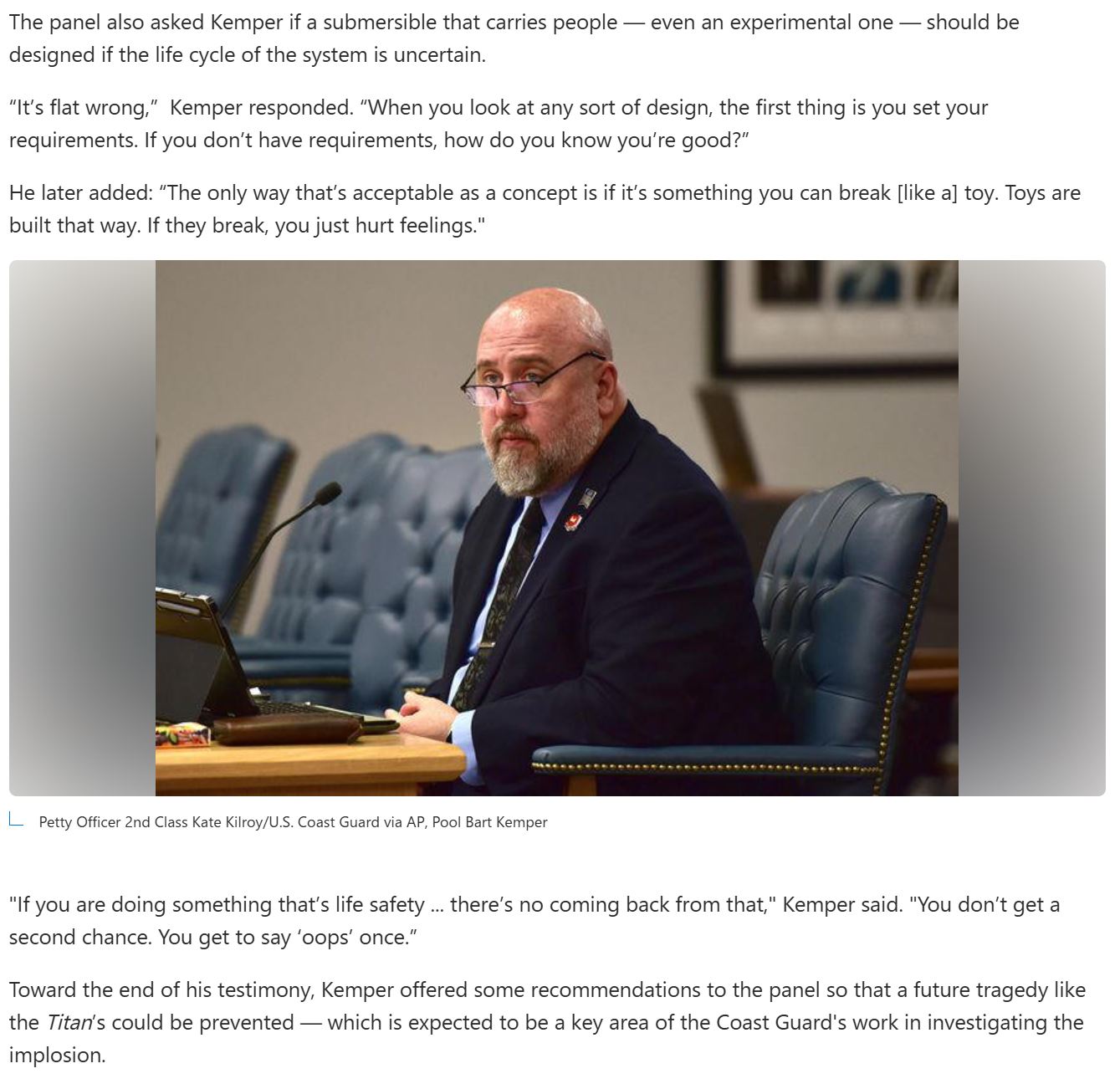
Bart Kemper, PE, DFE gave testimony at the US Coast Guard Marine Board of Investigation (MBI) regarding OceanGate and the Titan Submersible. He led a team of 13 KES staff and consultants to review the technical information provided by the US government. (People Magazine, 26 SEP 2024)
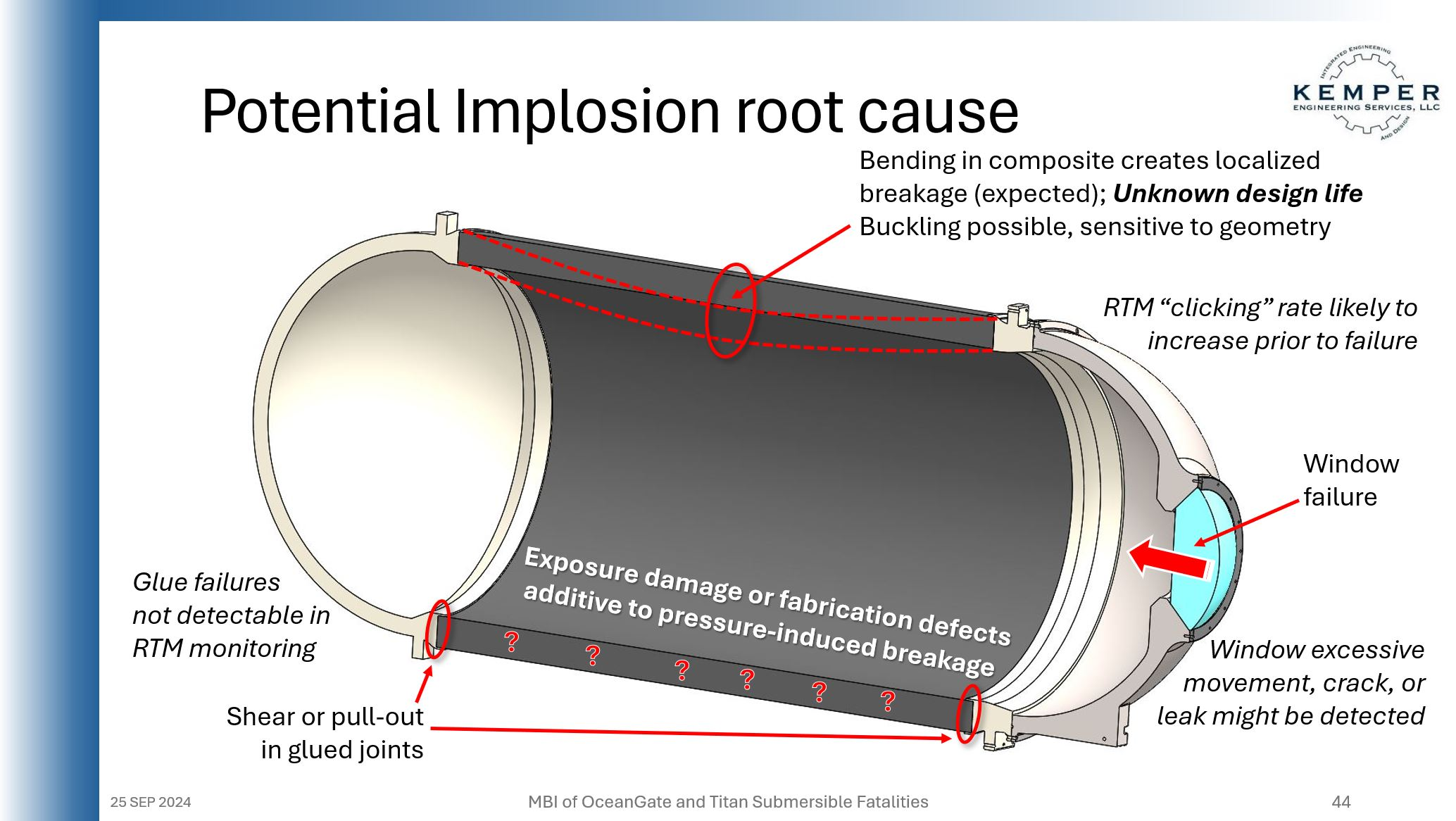
FROM MBI PRESENTATION: These are the potential single-mode failure points identified by the KES team.
Recent Comments