Bart Kemper was the opening Keynote Speaker for the 2025 ASME Verification, Validation, and Uncertainty Quantification (VVUQ) Conference, held April 9-10, 2025 in Bryan, Texas. His keynote address was titled, “Innovation, Ethics, and spreading the word of VVUQ.” This was based on his paper, “Oceangate, the Titan Submersible, and the Role of VVUQ in Innovation,” which is a more detailed look at his testimony about VVUQ provided at the 2024 USCG Marine Board of Investigation. The conference was held after several days of VVUQ codes and standards meetings, where Bart is a member of the Subcommittee VVUQ10, Solid Mechanics.
The keynote expanded on the paper’s conclusion that new technology will inherently be outside of codes and standards. It takes time to develop “what works in the field” into “established practices,” and then develop a code committee to agree on “what right looks like.” VVUQ, also known by its older term Verification and Validation (V&V), is the due diligence to use experiments and simulations in the design evolution process to responsibly innovate and manage risk. The tieback to the TITAN submersible is that OceanGate was correct that innovating with carbon fiber is outside the codes, so staying within the codes would prevent this attempt at innovation; however, OceanGate failed by not using VVUQ methods (which is what the Classification societies would have required) to manage their design risks.
The larger lesson, and the point of the keynote address, is that VVUQ is the standard of care for innovation when codes and standards do not apply. As our society continues to develop novel technologies and industry disruptors, the engineer is still responsible to hold paramount the safety, health, and welfare of the public. Codes and standards are guiderails, often “written in blood” from accidents and disasters, that give the engineers a proven method with an understood and accepted risk based on past events. VVUQ are the tools to look towards the future and provide a basis for predicting and evaluating the risks in the project. It’s also related to the IEEE paper published in IEEE Reliability Magazine, “VVUQ, Reliability, and the Law,” where the point is VVUQ provides the standard of care in using engineering simulations, therfore VVUQ is the standard of care for simulations in forensic work.
Keynote Address “Innovation, Ethics, and spreading the word of VVUQ.” (slide deck): DOI: 10.13140/RG.2.2.22478.78404
ASME Paper, “Oceangate, the Titan Submersible, and the Role of VVUQ in Innovation”: DOI: 10.1115/VVUQ2025-152480
IEEE Reliability Magazine, “VVUQ, Reliability, and the Law”: DOI: 10.1109/MRL.2025.3532564
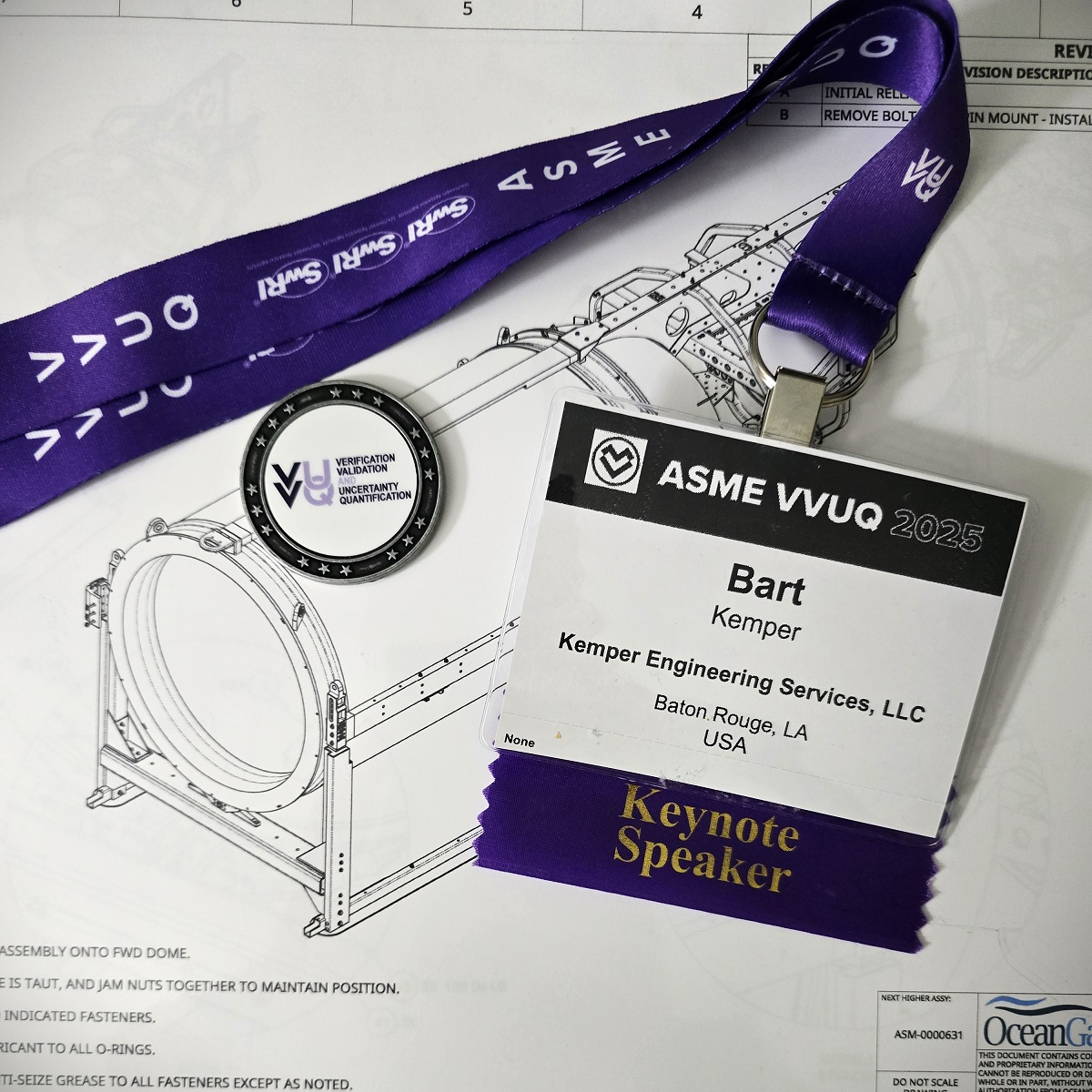
Bart received the ASME VVUQ “challenge coin” for a successful keynote address.
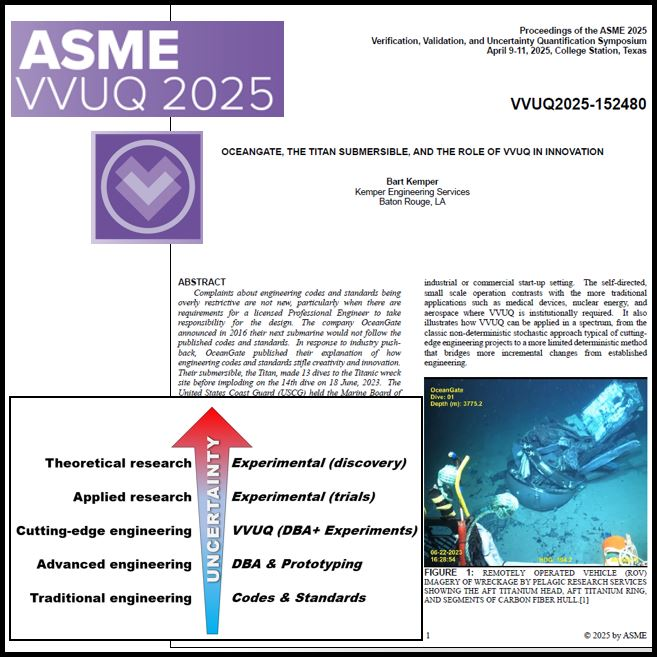
Oceangate, the Titan Submersible, and the Role of VVUQ in Innovation. This is the paper that was submitted and accepted by the conference before Kemper was asked to provide the keynote. The graphic shows the concept that uncertainty increases with novelty, which emans the requirements for VVUQ increases with novelty. Link to the paper is shown above.
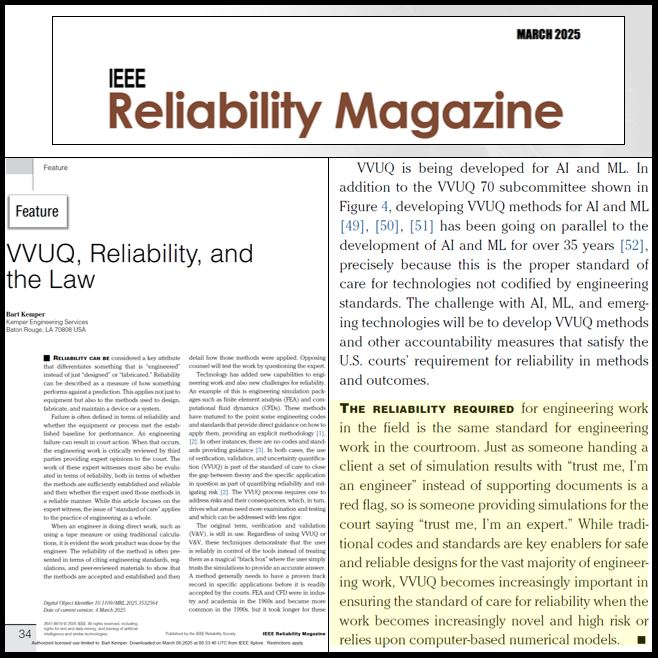
First page and key passage for the IEEE Reliablity Magazine paper, “VVUQ, Reliability, and the Law”
Recent Comments